
Novo-Diveevo Cemetery Restoration
Откройте сайт на русском языке
Cemetery Restoration Work at Novo-Diveevo Cemetery Enters its Fourth Year
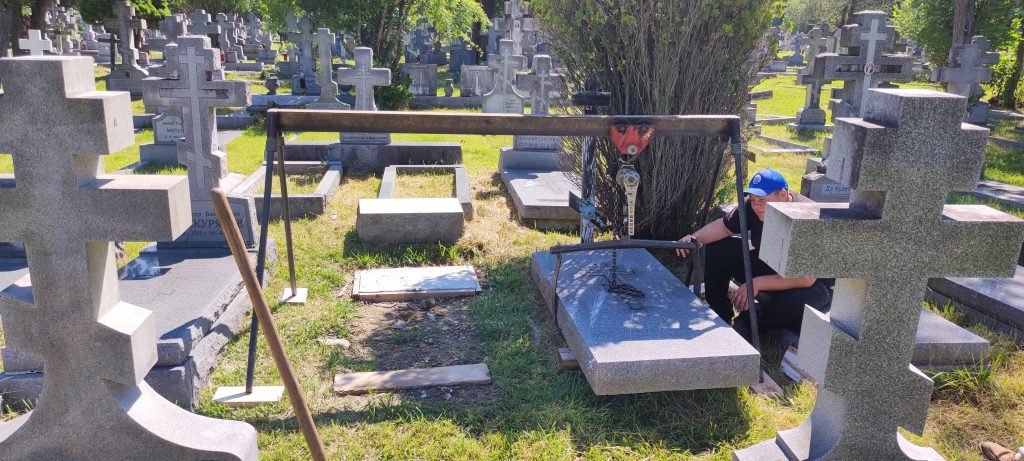
The Novo-Diveevo Holy Dormition Convent in Nanuet, New York is home to the largest Orthodox cemetery in America, with over 9,000 individuals interred there. It is rightfully considered an open-air historical museum of the Russian emigration.
Time, together with bad weather including major storms, can and does cause damage to many of the graves and memorials, destroying the crosses and gradually erasing the names of the deceased. Several years ago, a group of volunteers — parishioners of the Monastery — and donors began restoration and renovation work to preserve this cemetery as an important historical site.
The donations were used to successfully carry out repairs for two seasons. The committee planned a reasonable volume of work for the upcoming season, and reported on the funds collected and material costs, providing photographs of the damaged graves before the work began and upon completion of the restoration.
To date, work had been carried out on the so-called “Military” section of the cemetery.
The current restoration project includes graves in the oldest section of the cemetery, where the founder of the Monastery and the cemetery itself, Archbishop Andrey (Rymarenko), rests.
Many crosses have a modest, laconic inscription, for example, “Servant of God’s Love” or “White Army Warrior Vladimir.” However, after 75 years, it is very challenging in some cases to establish the biographies of the deceased. There are many crosses that have fallen on their front side to the ground. And before the restoration work begins, it is challenging to find out whose grave this is.
This area was most severely damaged by Hurricane Sandy, and falling trees destroyed a number of crosses.
Ways You Can Help
News and Updates
September 5, 2026: Cemetery Restoration Project Enters its Fourth Year (see below)
December 17, 2025: Report on Novo Diveevo Cemetery Restoration Work for 2025. Read about our previous work.
September 18, 2025: New restoration work has begun. Read about our previous work.
January 21, 2025: Report on Novo Diveevo Cemetery Restoration Work: 2024 Monument Repairs Have Been Completed.
June 26th, 2024: New restoration work has begun. Read about our previous work.
November 8th, 2023: Report on Restoration Work: The first goals for the restoration of monuments at the Novo-Diveevo cemetery have been achieved!
Adopt a grave
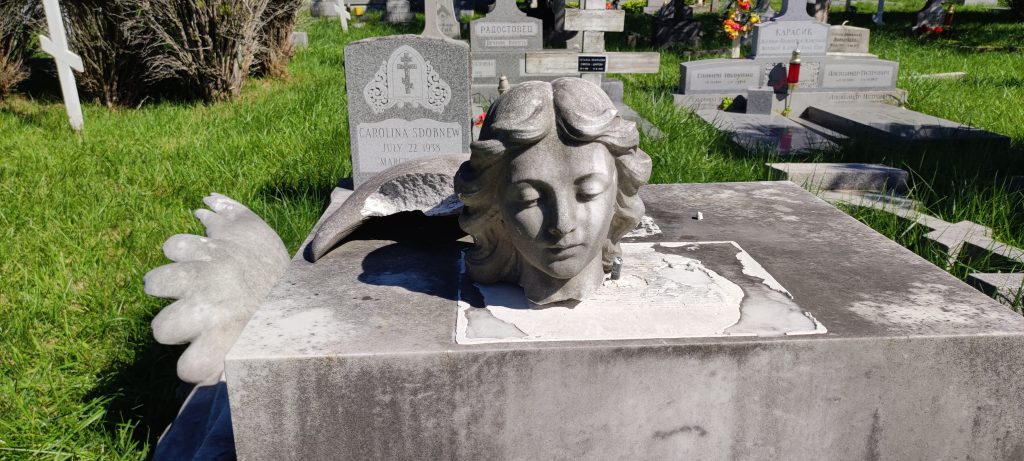
Sadly, many of the people buried here no longer have relatives who could take care of the graves. Recently, visitors to the cemetery have asked permission from the monastery to help ennoble and take care of abandoned graves. We are pleased to offer the start of this charitable project.
As a first step, five tombstones in serious need of repair were identified and designated for restoration. The estimated cost of this initial restoration work is approximately $5,000, and this project requires financial support for the repair of these tombstones. The grave monuments were selected from across the various types found in the cemetery, e.g., marble, granite and wooden monuments.
All those who are able to offer financial assistance for the restoration of monuments will be provided with a full report on the expenditure of funds for specific work, photos of the work process, as well as “before” and “after” photos will be published upon completion of the restoration.
Cemetery Restoration Project Enters its Fourth Year
Dear brothers and sisters!
Thanks to your heartfelt generosity and financial contributions, the restoration project for the Novo-Diveevo Convent cemetery is continuing.
The Committee has previously reported on the work accomplished and the funds and materials expended.
The fourth season is now under way.
We once again appeal for help to all those who share our interests—those for whom Russian history and the history of the Russian emigration hold deep significance. The Orthodox cemetery at the Novo-Diveevo Convent is the largest in America, containing over 9,000 graves. It is a site of cultural and historical importance for the Russian diaspora. Resting here are scholars, writers, artists, military officers and sailors, representatives of old noble families of the Russian Empire, and members of subsequent generations of the emigration. It is, in effect, a museum of Russian history.
Yet time takes its toll. Gravestones and monuments are deteriorating. Volunteers repair and paint wooden crosses during regular work days in the spring and autumn; however, the restoration of marble and granite crosses requires additional effort and additional funds.
For this season, the Committee has scheduled the following gravesites for repair and restoration:
- The Burachek Family Plot
- Erdeli Family Burial Plot
- Sokolov Family Burial Plot
- Elizaveta Nikolaevna Yarminskaya
- Maria Vasilievna Borisova
- Sukk Family Burial Plot
- Oleg Evgenievich Borisov-Morozov
- Rostislav Mikhailovich Pavlovsky
- Zacharin Family Burial Plot
- Unidentified grave
- Unidentified grave
If you would like to contribute to the project please donate here:
The Burachek Family Plot
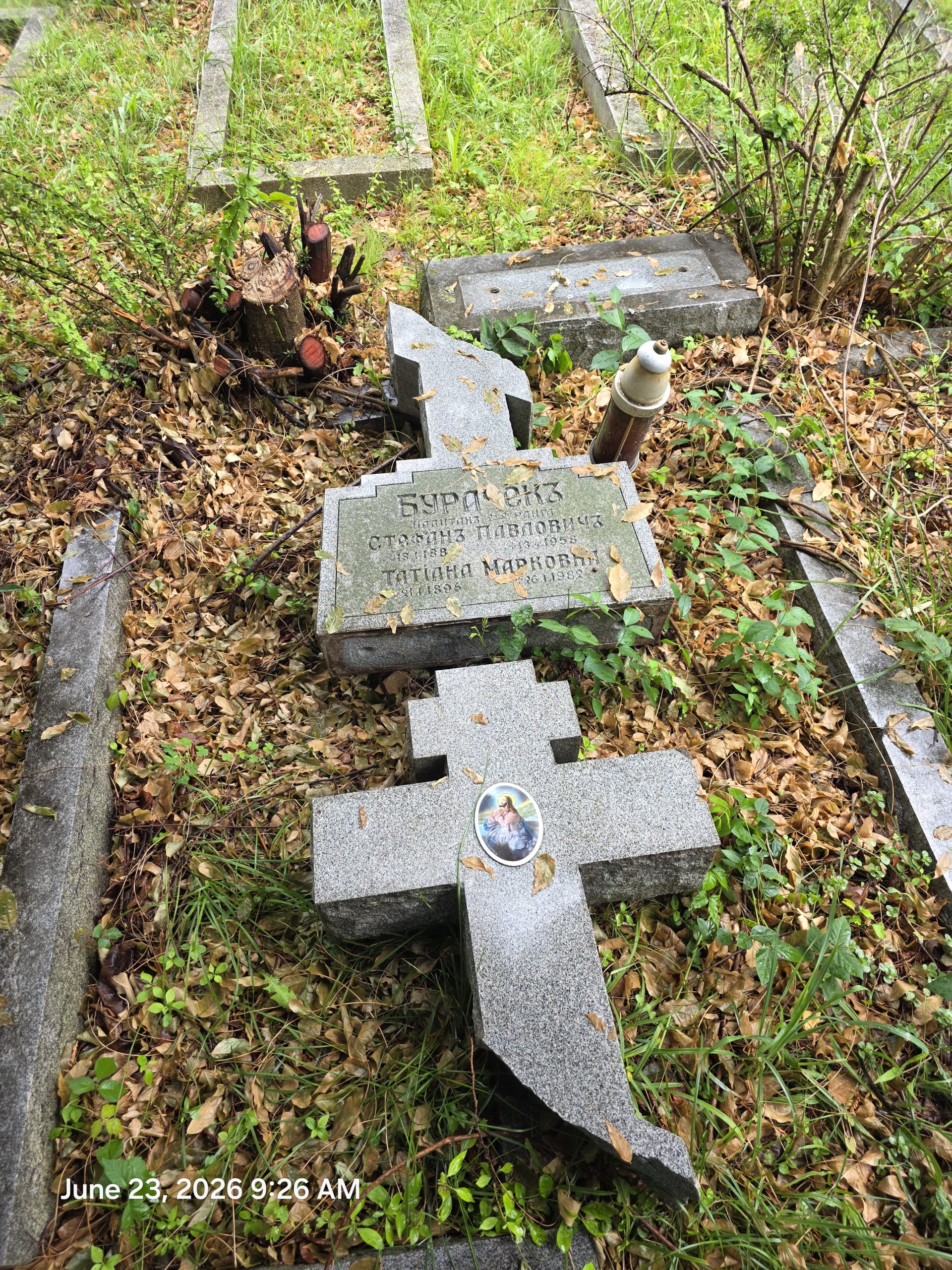
Stefan Pavlovich and Tatiana Markovna
Stefan Pavlovich Burachek.: A nobleman born in Kronstadt, he graduated from the Naval Corps in 1900. He held the rank of Captain 2nd Rank and served as commander of the Åbo naval crew and commander of the minesweeping division of the Arctic Ocean. From November 27, 1918, he served with the White forces of the Northern Front. He was in charge of the helmsmen and signalmen training school under the Naval Department. In the summer of 1921, he emigrated to Yugoslavia, and after 1945, to the USA. He was a member of the Union of Russian Seamen and a participant in the monarchist movement.
The large granite cross has shattered after falling from its pedestal. Plans are in place to reassemble, reinstall, and secure the cross onto the pedestal. The granite border of the grave enclosure, displaced by tree roots, also needs to be leveled.
Erdeli Family Burial Plot
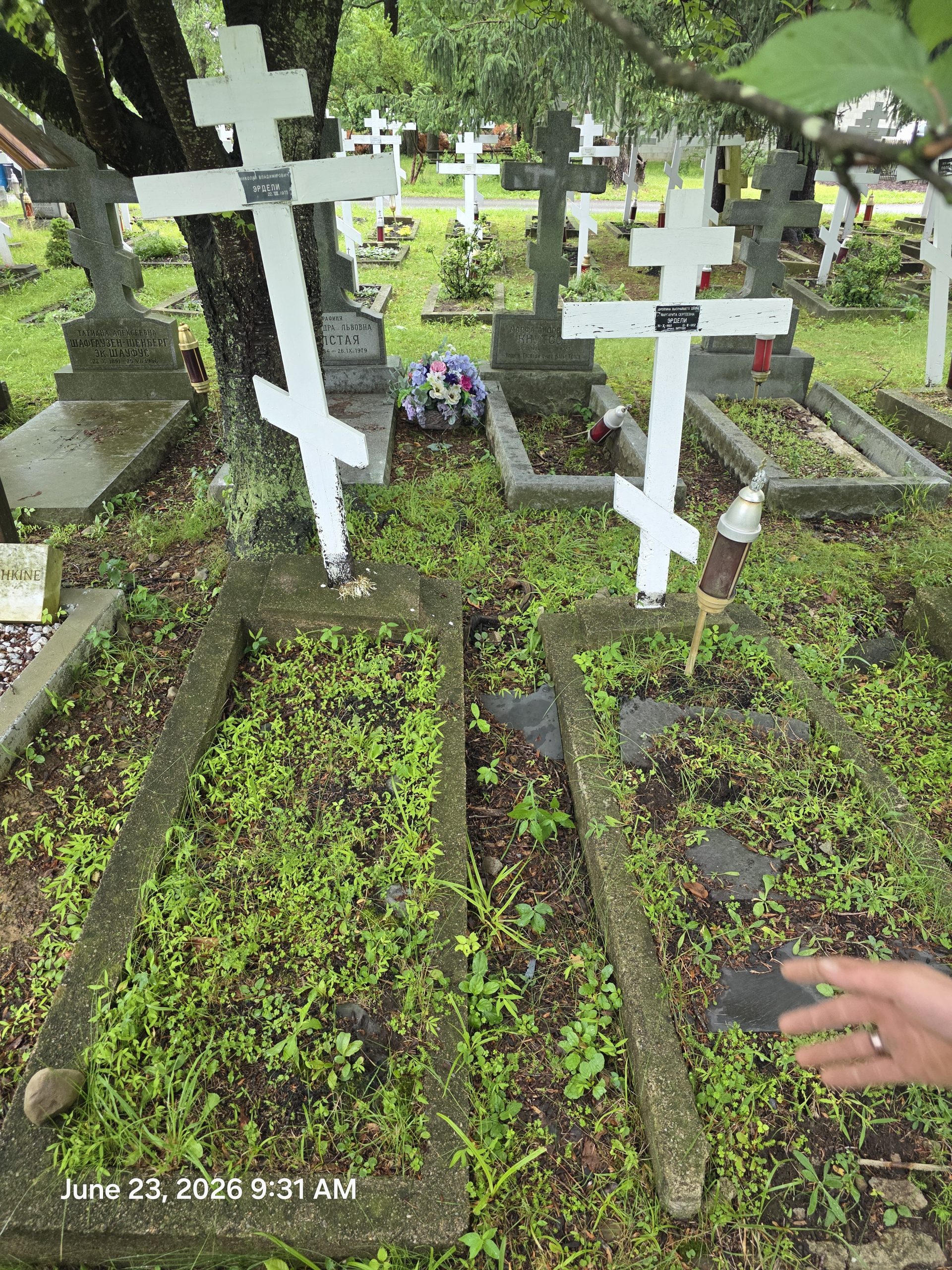
Vladimir Georgievich Erdeli
Margarita Sergeyevna Erdeli (née Khitrovo)
Nikolai Vladimirovich Erdeli
The Erdeli family belonged to the hereditary nobility of the Kherson Governorate. Their ancestors were Hungarian nobles—the surname literally translates as “Transylvanian”—who converted to Orthodoxy and settled in Russia in 1755. A great-great-grandfather served in the armies of Marshals P.A. Rumyantsev and A.V. Suvorov. An uncle, Ivan Georgievich Erdeli, was a General of the Cavalry and a veteran of World War I and the Civil War; he was a prominent figure in the White movement in Southern Russia, a participant in the “Ice March” (First Kuban Campaign), and a co-founder of the Volunteer Army.
Vladimir Georgievich Erdeli was not a military man.
Before the outbreak of World War I, he served as a press inspector in Ekaterinoslav.
His first marriage was to Elizaveta Nikolaevna Stroganova, a member of a renowned aristocratic family; his second marriage was to Margarita Sergeyevna Khitrovo, a lady-in-waiting at the Imperial Court.
Margarita Sergeyevna Khitrovo was a great-granddaughter of A.V. Suvorov. She graduated from the Smolny Institute with the distinction of the Imperial Monogram. She served as a nurse at Her Majesty’s Own Infirmary in Tsarskoye Selo alongside the Grand Duchesses. She was particularly close to Grand Duchess Olga Nikolaevna. Within the Imperial Family, she was known as Rita. She followed the arrested Imperial Family to Tobolsk. On the personal orders of Kerensky, she was arrested (August 22, 1917) and escorted under guard to Moscow.
The fearless, loyal, and self-sacrificing 22-year-old Rita Khitrovo attempted to organize an “Operation to Rescue the Imperial Family” on her own. Subsequently, there would be no serious attempt to rescue the Sovereign and his family.
Over time, the white wooden crosses rotted away, and the concrete grave borders shifted and separated due to soil erosion and tree roots.
Sokolov Family Burial Plot
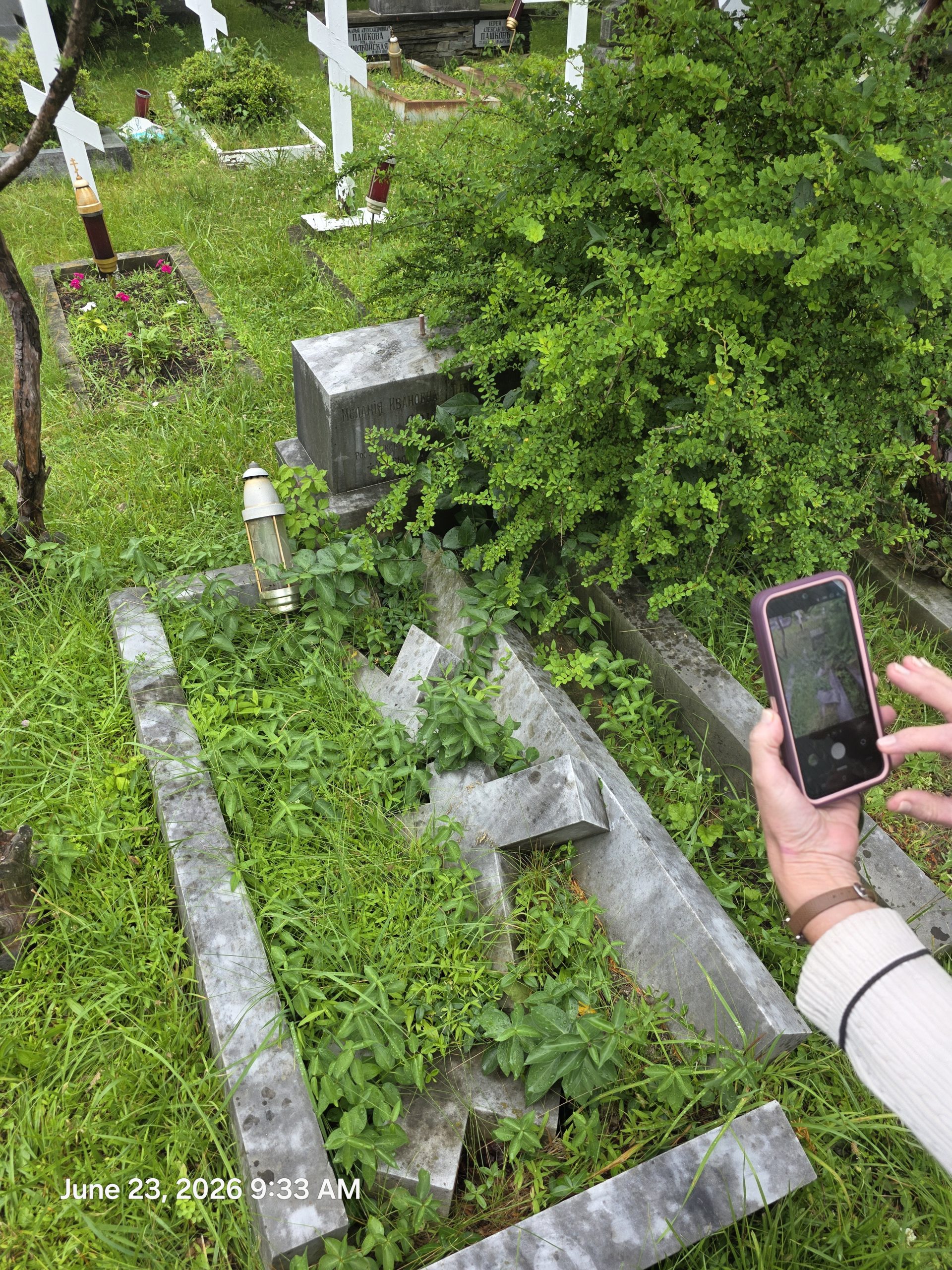
Pavel Platonovich and Malaniya Ivanovna
The granite cross has fallen and shattered. The granite border beams have become deformed and shifted due to tree roots.
Elizaveta Nikolaevna Yarminskaya
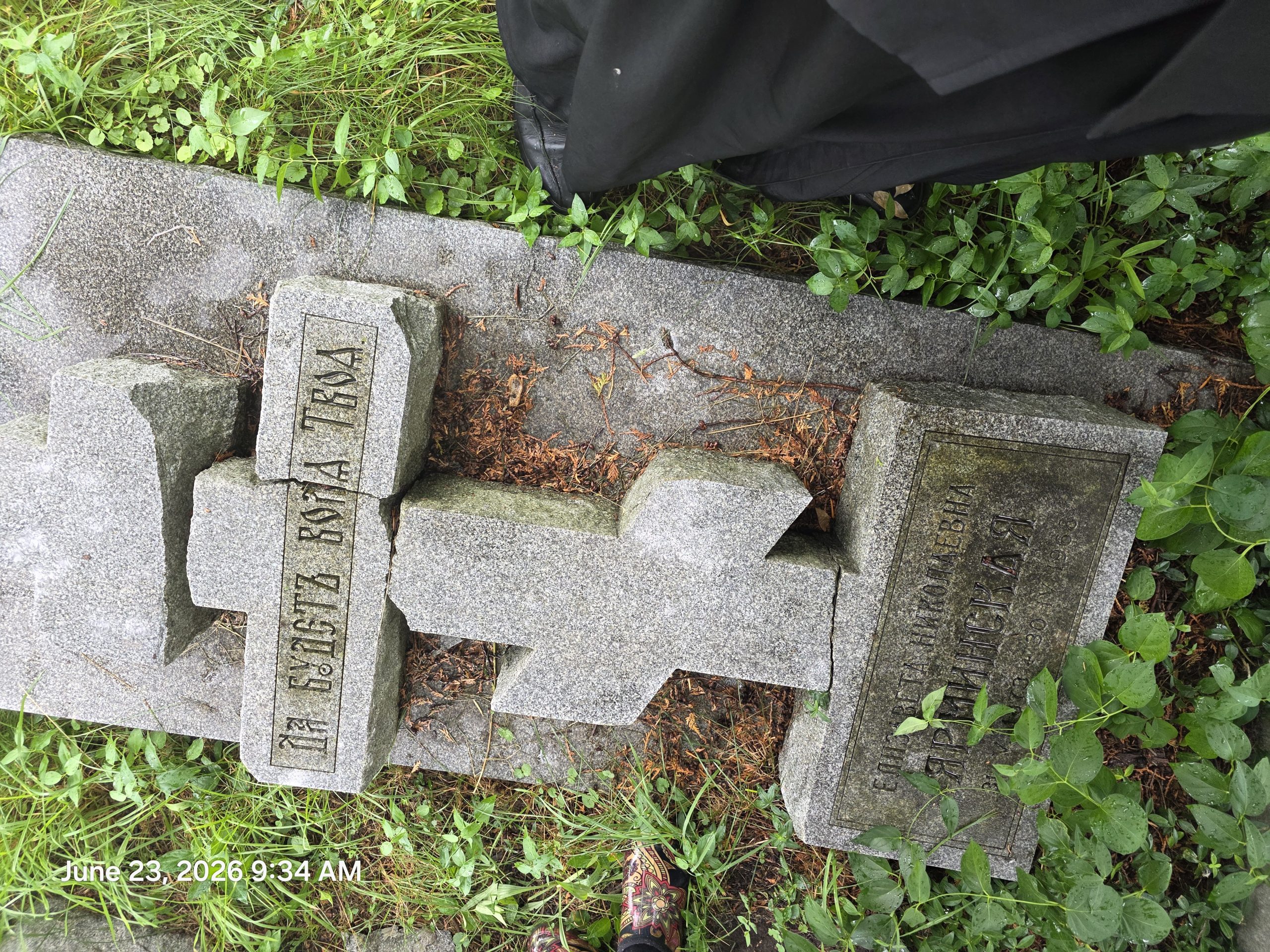
The granite cross has shattered upon falling.
Maria Vasilievna Borisova
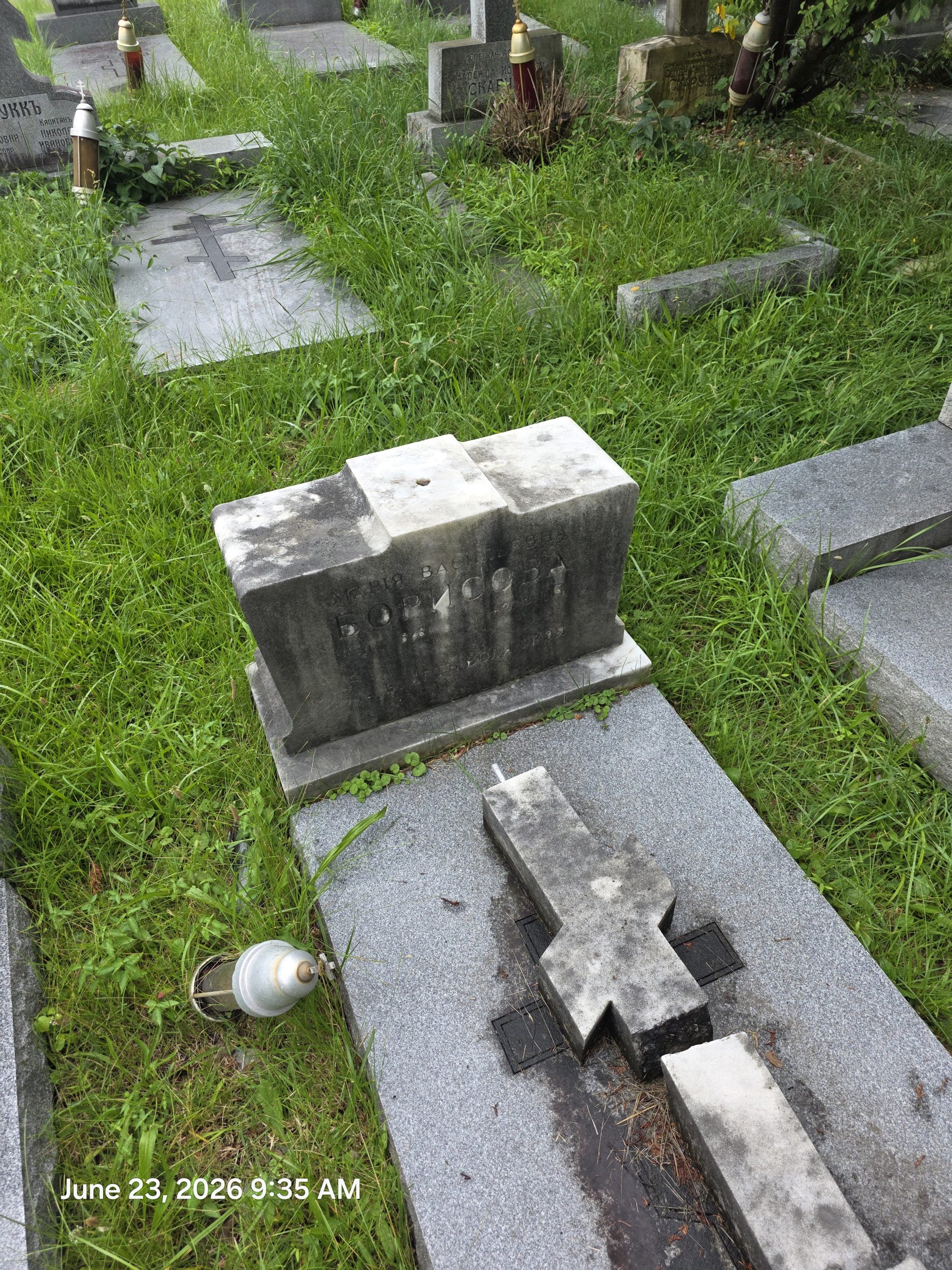
The white marble cross has shattered into small pieces upon falling.
Sukk Family Burial Plot
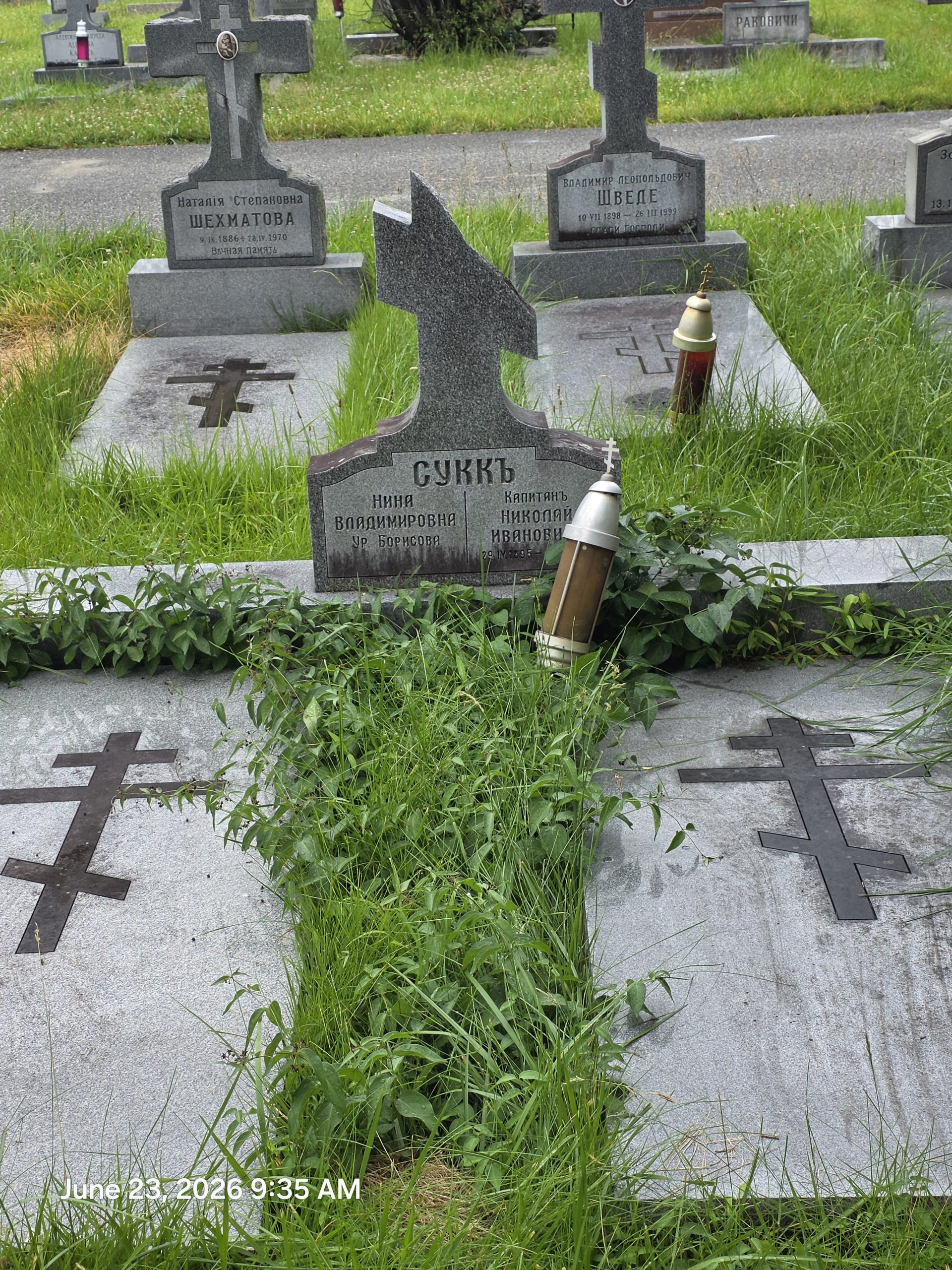
Nikolai Ivanovich, White Army Captain.
Nina Vladimirovna
The granite cross has been broken into two pieces.
Oleg Evgenievich Borisov-Morozov
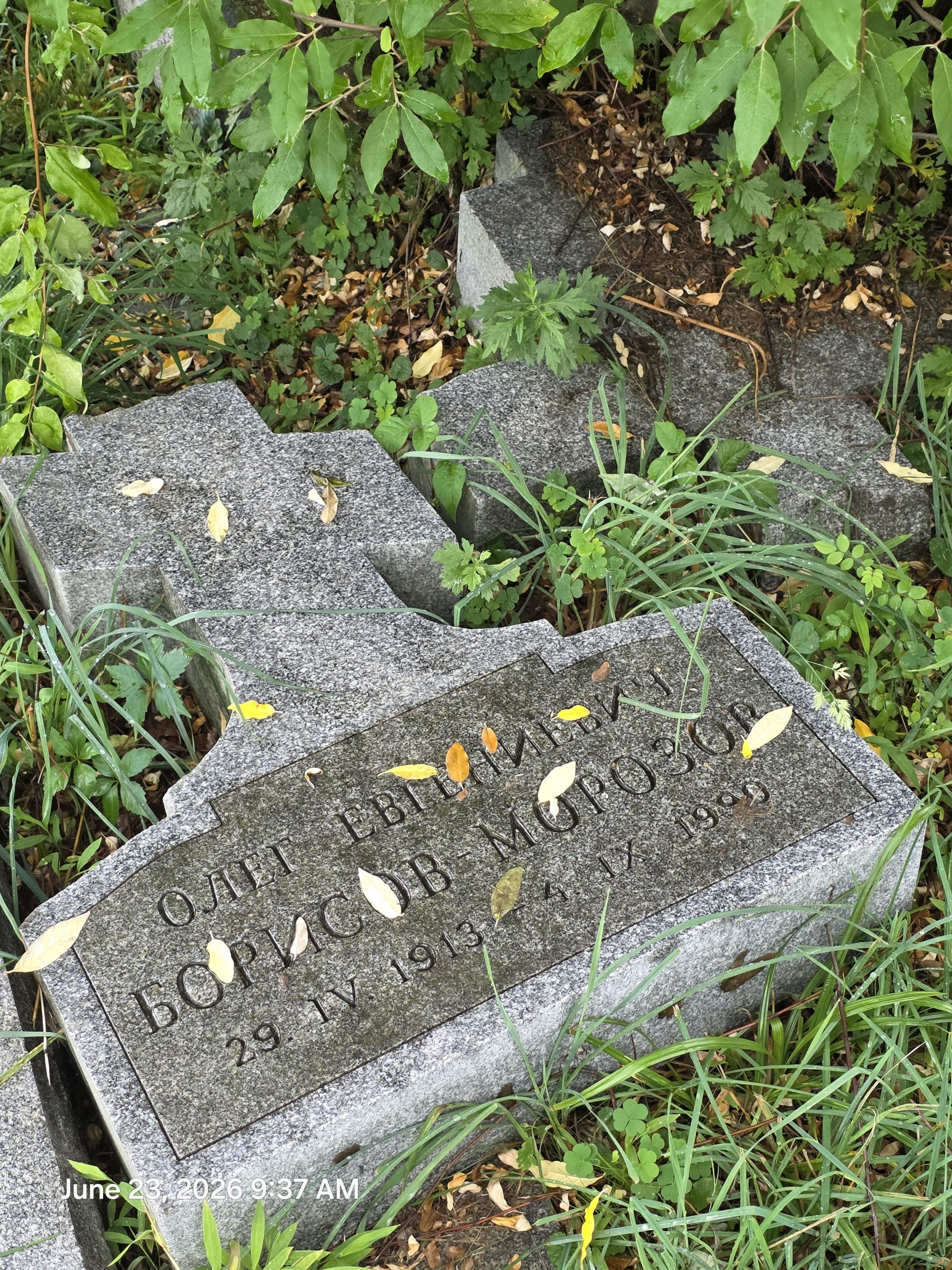
The granite cross has shattered upon falling. Tree roots have deformed the soil beneath the grave border.
Rostislav Mikhailovich Pavlovsky
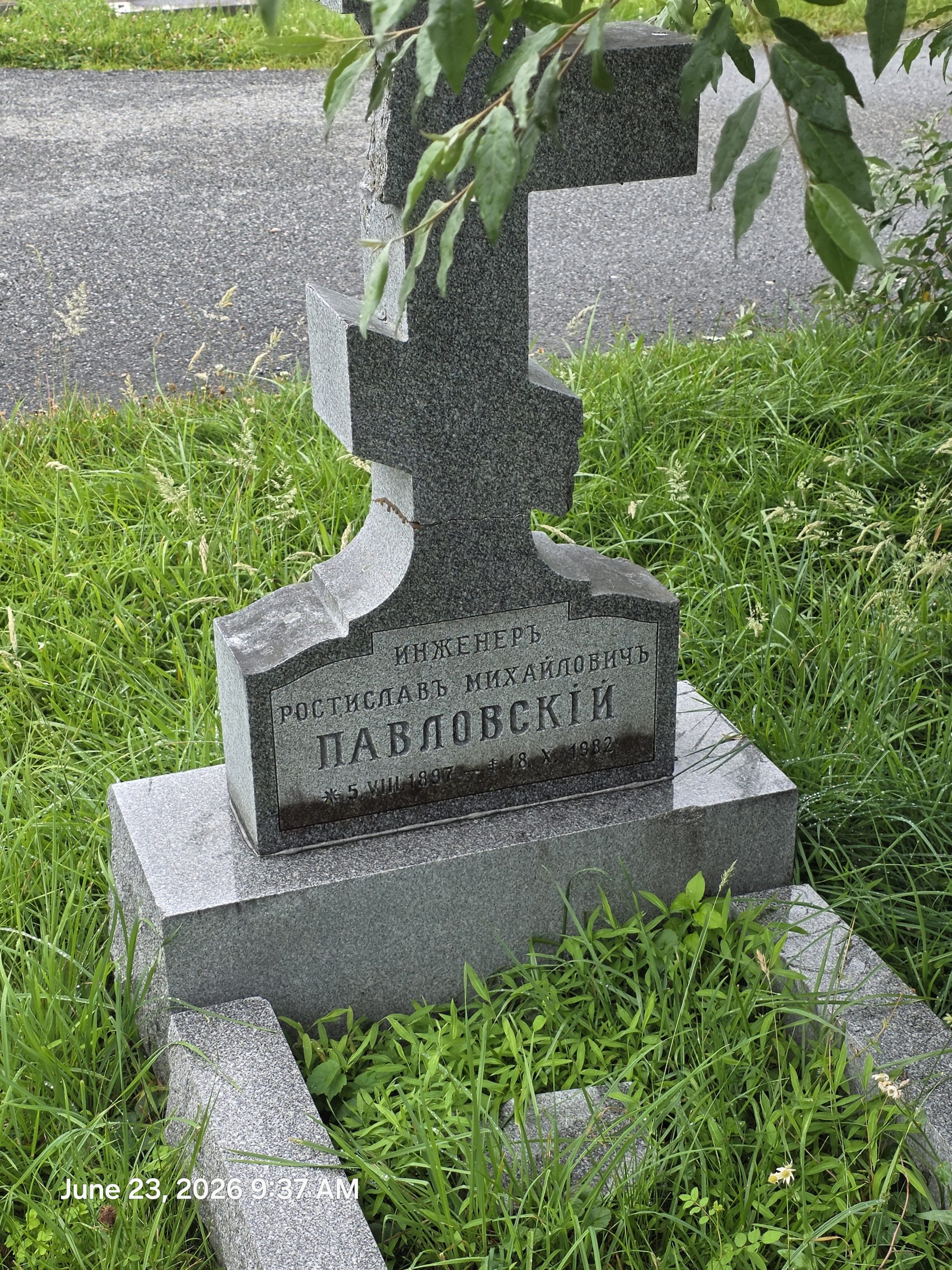
Engineer. Member of the Union of Russian Engineers.
Granite cross: the left arm of the cross has broken off.
Zacharin Family Burial Plot
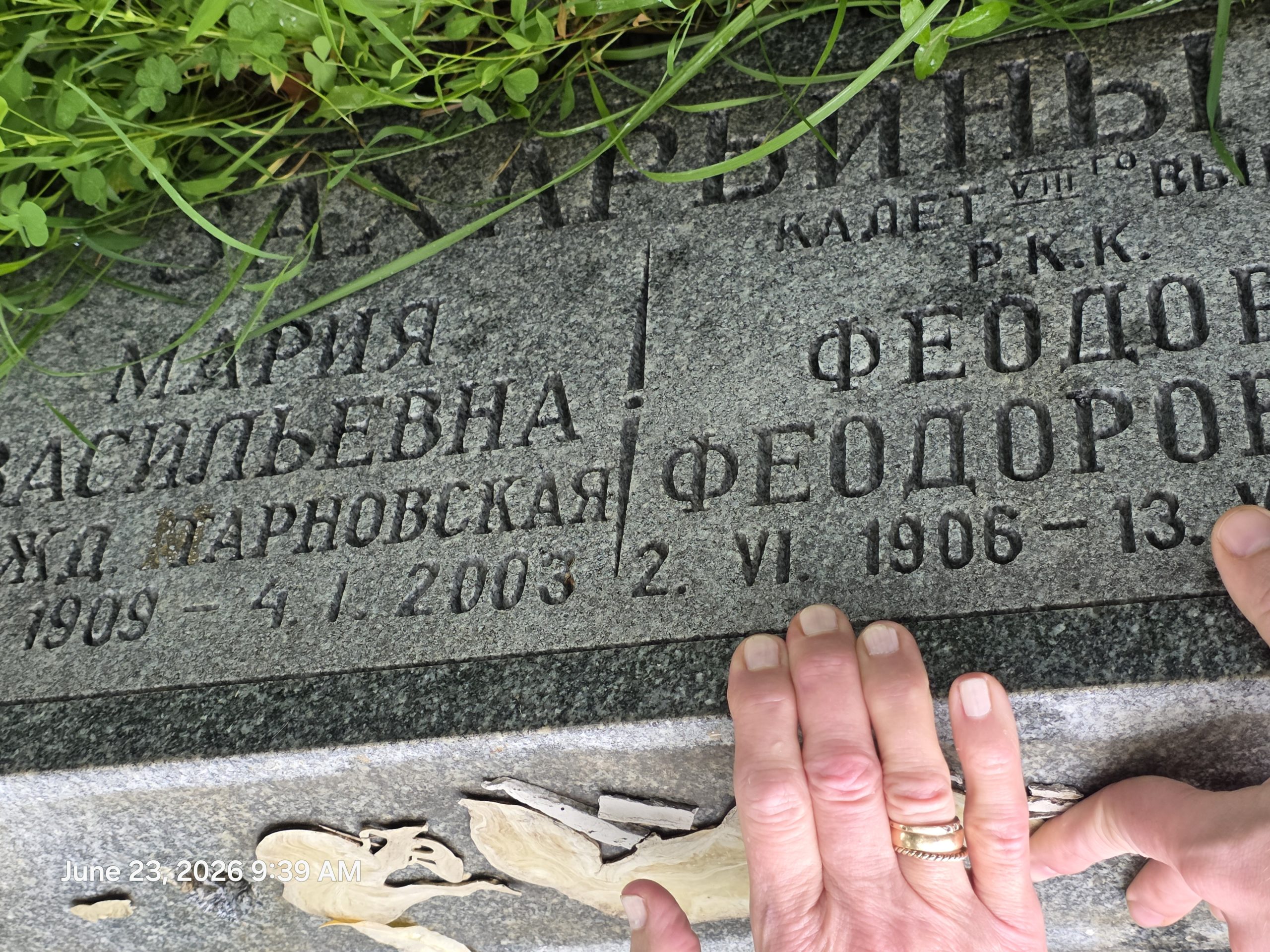
Feodor Feodorovich, cadet of the 8th graduating class of the Russian Cadet Corps. Maria Vasilievna
The Zacharins were an ancient boyar family known since the early 15th century. The family’s progenitor, the boyar Roman Yuryevich Zacharin, was the father of Tsar Ivan the Terrible’s first wife.
F.F. Zacharin was born in Kyiv. During the Civil War, the family emigrated via Crimea to Yugoslavia, where Fyodor Zacharin graduated from the Russian Cadet Corps in Sarajevo. He emigrated to the USA in 1954. He was actively involved in Russian community life, serving as a senior officer of the Cadet Association, treasurer and secretary of the Russian Center, and a member of the audit commission of the Relief Union at the House of Free Russia.
The granite cross and pedestal have fallen over and shattered.
Unidentified Grave (as of now)
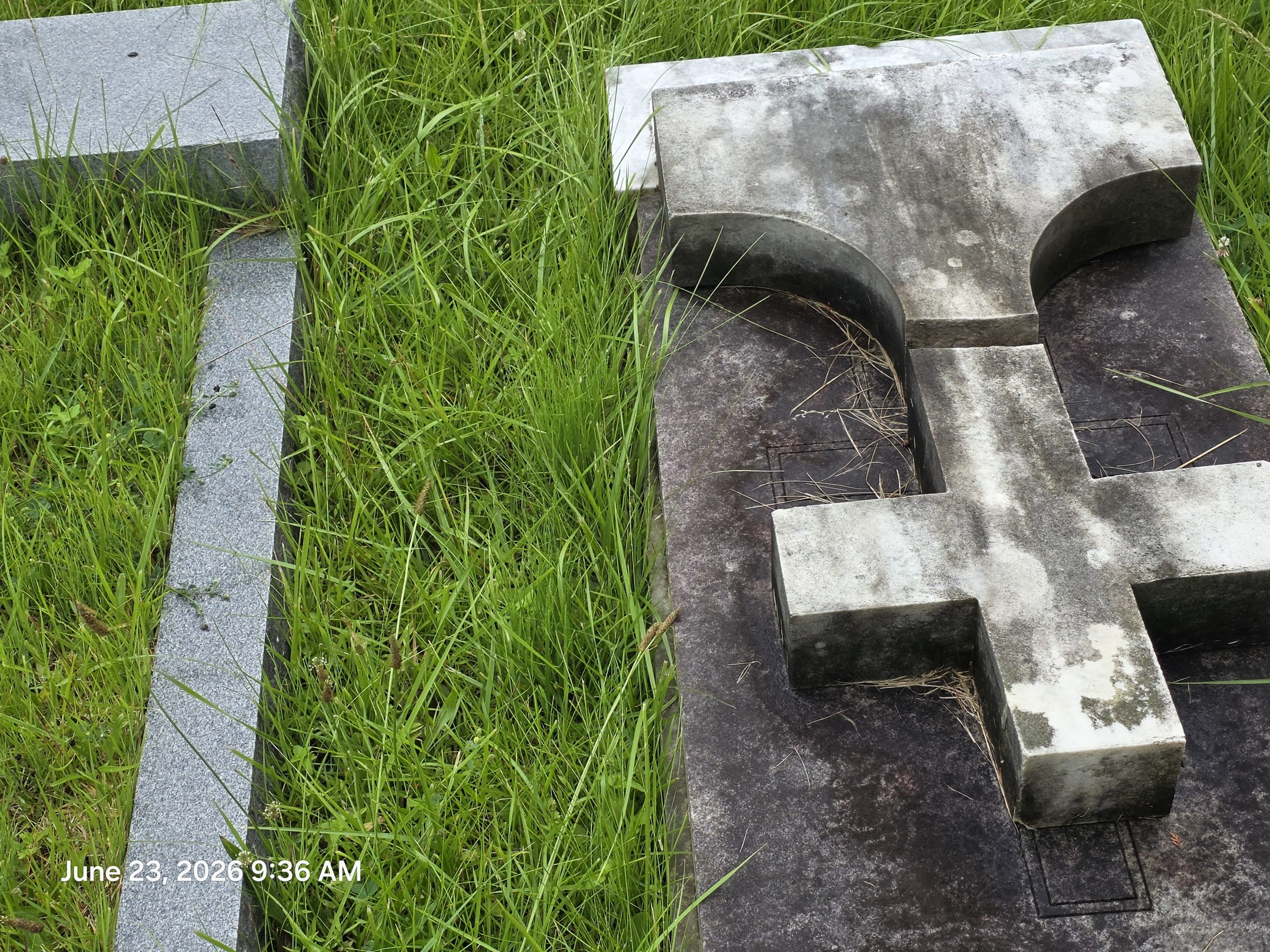
The cross has fallen face-down onto the grave slab.
The granite cross has shattered. It needs to be glued back together and reinstalled on the pedestal.
Unidentified Grave (as of now)
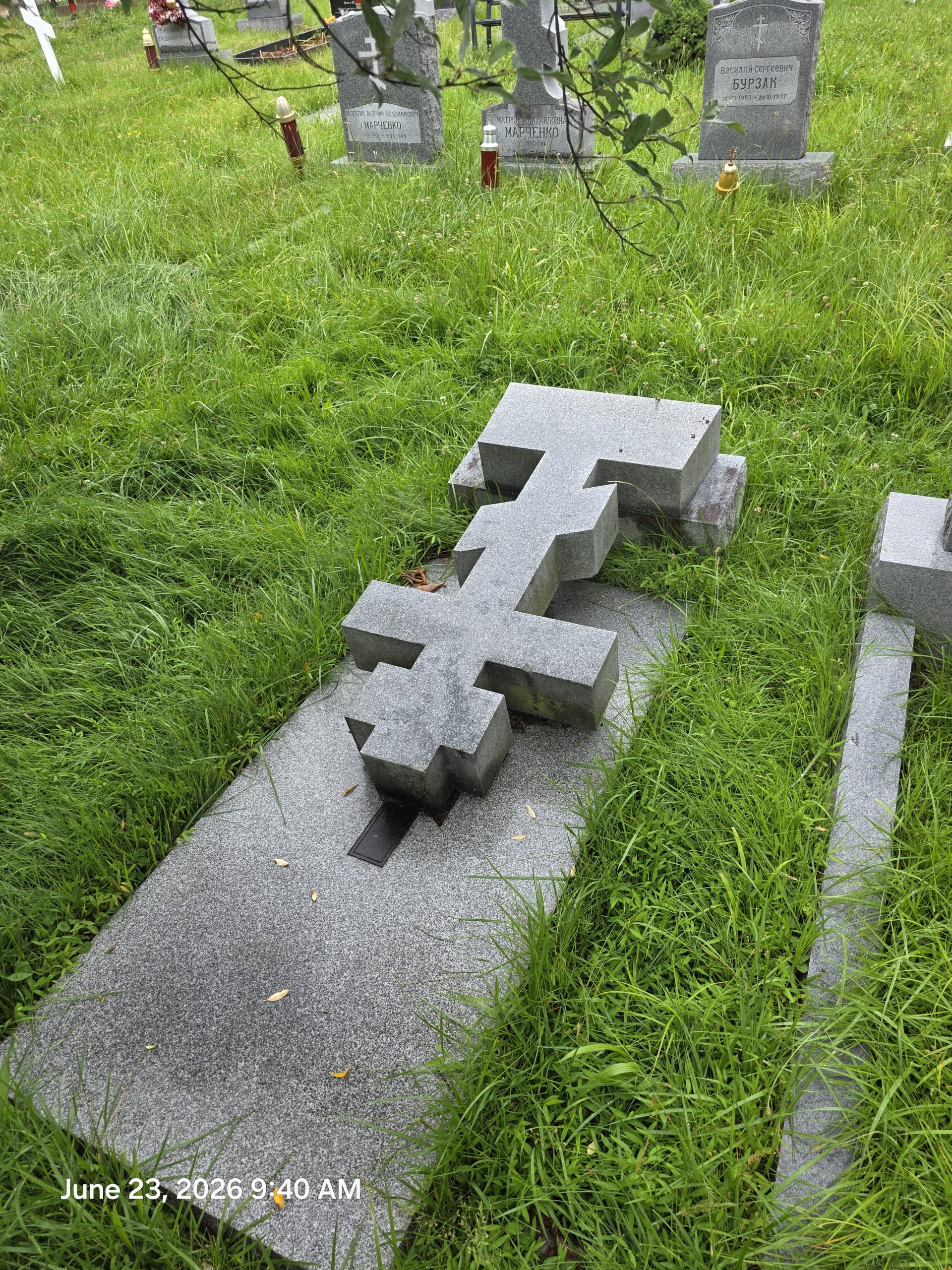
The granite cross and pedestal have fallen face-down onto the granite grave slab. It did not break.
It needs to be lifted, set in place, and cemented.
The Restoration Committee expresses its gratitude to all donors and volunteers for their financial support and physical assistance, and, especially, to Karassik Monuments and to the cemetery workers for their selfless work in preserving the historical memory and cultural heritage, which this largest Orthodox cemetery in America represents.
Plant a Birch Tree in Memory of Your Loved Ones
Novo-Diveevo Cemetery is now offering an opportunity to plant birch trees in specific locations at the cemetery. While trees are no longer permitted at individual grave sites, we would like to offer this opportunity for family members to pay respects to their loved ones by planting a birch tree and at the same time to participate in the beautification of our cemetery.
Volunteer Your Time at the Cemetery
For those who would like to make friends for the glory of God and personally help in the improvement of the cemetery, you can visit during our working hours (Monday to Friday from 7am-4pm) or on Saturday and help the workers of the monastery in restoring wooden crosses, cleaning the cemetery territory and generally to support other needs of the cemetery. Please contact us via email at [email protected] or call the monastery office at 845-356-0425.
Donate for Repair Materials
Another way to support the monastery’s efforts is to help with the procurement of materials needed for restoration of the monuments, for example, paint, special bonding cement, and the like. For more information, please contact us via email at [email protected] or call the monastery office at 845-356-0425.
Other Ways to Help
- General volunteer Saturdays
Occasionally we will have opportunities for all those people willing to help to gather on a set date and work for the glory of God together. Such days will be announced 1-2 weeks in advance. You can subscribe to our newsletter, check online or call the office to find out more. - Donate equipment
Please call the cemetery office 845-356-0425 if you have any equipment you can donate for any of the aforementioned projects. - Help us cover Grass cutting costs at the cemetery
It costs over 30K a year for landscaping costs and maintenance. The high price is due to the fact that the cemetery allows frames and grave covers, which make it more difficult to cut the grass around graves on a monthly basis. Any and all financial support is appreciated and we thank you in advance.